
Research & Discovery
HKU-BNU Collaboration Sheds Light on Dark Matter Physics
For nearly a century, dark matter has been one of the most persistent, puzzling mysteries in physics.
Despite comprising an estimated 85% of all matter in the Universe, dark matter is absent from the Standard Model of particle physics – the current framework for classifying the elemental particles of the universe.
Part of the challenge is that dark matter does not emit, absorb, or deflect light, meaning it can only be detected through its gravitational effects. But scientists may be getting closer to answering some of the most important questions about dark matter, as growing astronomical evidence suggests it may in fact consist of ultralight particles, which collectively behave like waves due to their extremely low masses.
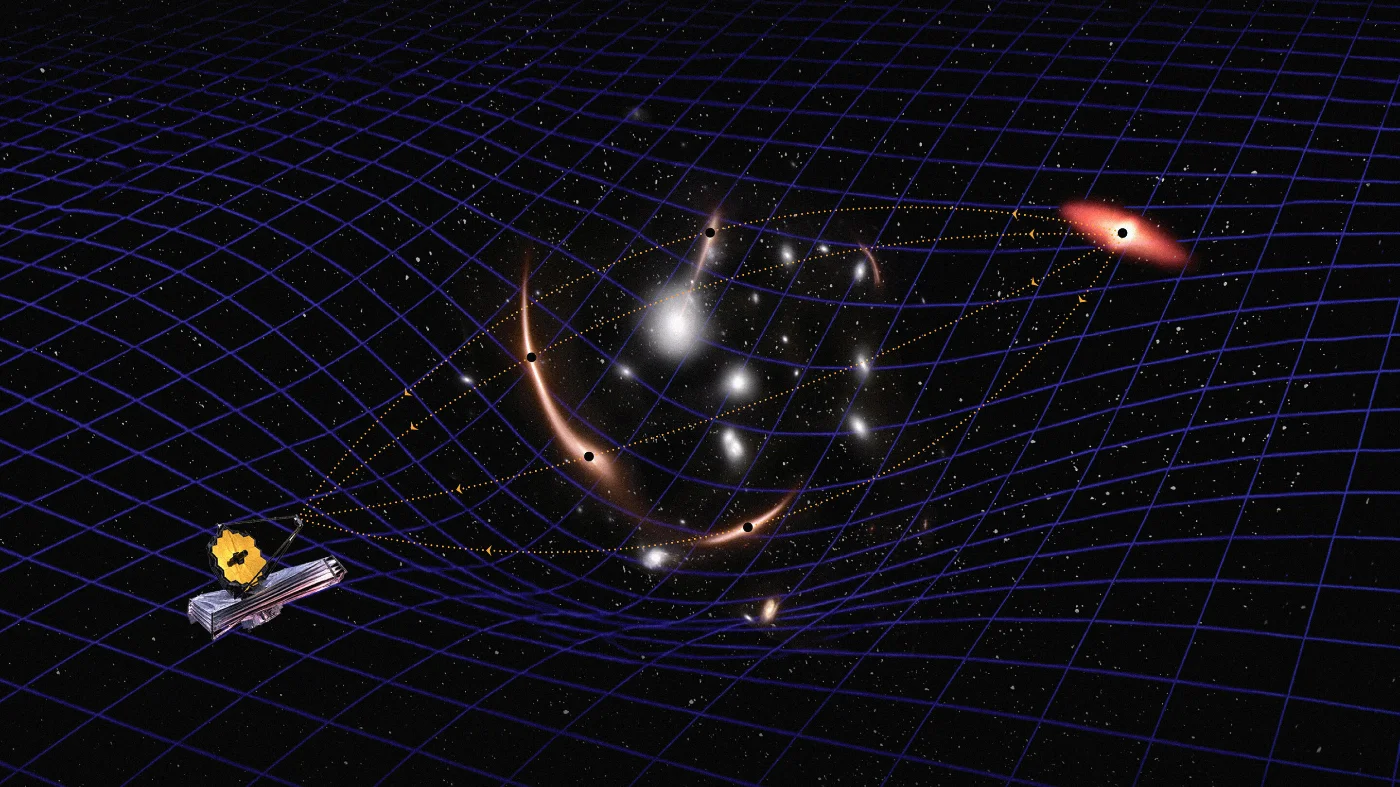
Now, a new study conducted by astrophysicists from the University of Hong Kong working together with a team from Beijing Normal University has developed a new, more physically realistic approach to testing how these ultralight dark matter particles influence gravitationally lensed images – pictures of distant space objects that appear distorted due to foreground objects’ gravitational impact on light waves.
The team, including Professor Jeremy Lim and Dr Amruth Alfred from HKU’s Department of Physics and The Hong Kong Institute of Astronomy and Astrophysics (HKIAA), began by making predictions for the properties of gravitationally lensed images based on the idea that galaxies are indeed composed of ultralight dark matter.
Their results, published in Nature Communications, show that the resulting simulations reproduced the observed positions of the lensed images more closely than the comparison models used in the study, suggesting that gravitationally lensed systems could provide a way to test ultralight-dark-matter models while highlighting the potential of high-resolution gravitational-lensing observations to probe the nature of dark matter.
The project grew out of close collaboration between the HKU researchers and Professor Zong-Hong Zhu’s group at BNU, including Dr Zhengxiang Li and PhD student Jiajun Zhou, the lead author of the study.
“We were very excited to see what the simulations predicted as we did not know beforehand what observable signatures to expect,” says Professor Jeremy Lim. “(W)e believe this has opened entirely new avenues for future research on the nature of dark matter using lensing."
Moving forward, the researchers plan to investigate other effects, including changes in the brightness of gravitationally lensed images.
Related Topics
Related News